
Resin is the largest single line item in most glue mixes, so every mill extends it. The question was never whether to, but how far you can go before the glue line starts giving something back — and how you would know if it had.
Extension gets a poor reputation because it is often done with whatever cheap filler is to hand, judged on cost per kilo, and reviewed only when panels start failing. Treated as a formulation decision instead, it is one of the few changes that reduces cost without costing performance.
What an extender is actually doing
An extender is not simply bulk. It occupies volume in the adhesive matrix, and in doing so it changes two things that decide whether a bond survives: how thick the mix is, and how far it travels into the veneer.
Both matter more than they sound. A glue line only bonds where there is glue between two surfaces. Adhesive that has soaked into the timber is not in the glue line any more — it is in the wood, doing nothing for adhesion and costing you the same money.
The two ways extension goes wrong
Almost every extension failure is one of these, and they look nothing alike on the press.
- Starving the glue line. Push the replacement ratio too high and there is not enough reactive resin left to build a continuous polymer network. Panels pass a quick pull test and fail on boil or after conditioning, because the bond was never properly formed.
- Over-penetration. Thin the mix, or use a filler that does not hold viscosity, and adhesive disappears into open, porous veneer. The symptom is a starved glue line even though the dose sheet says the resin is all there.
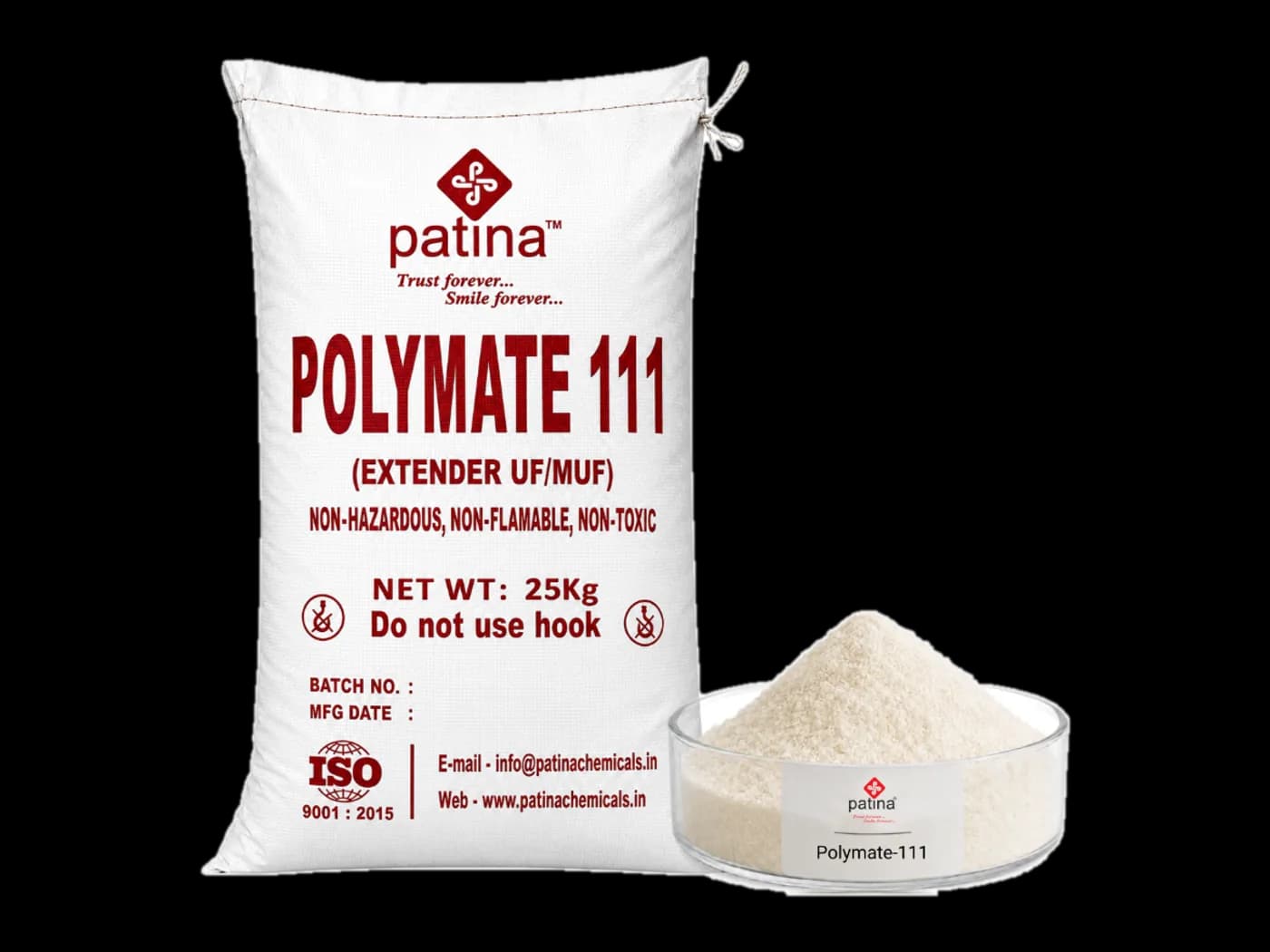
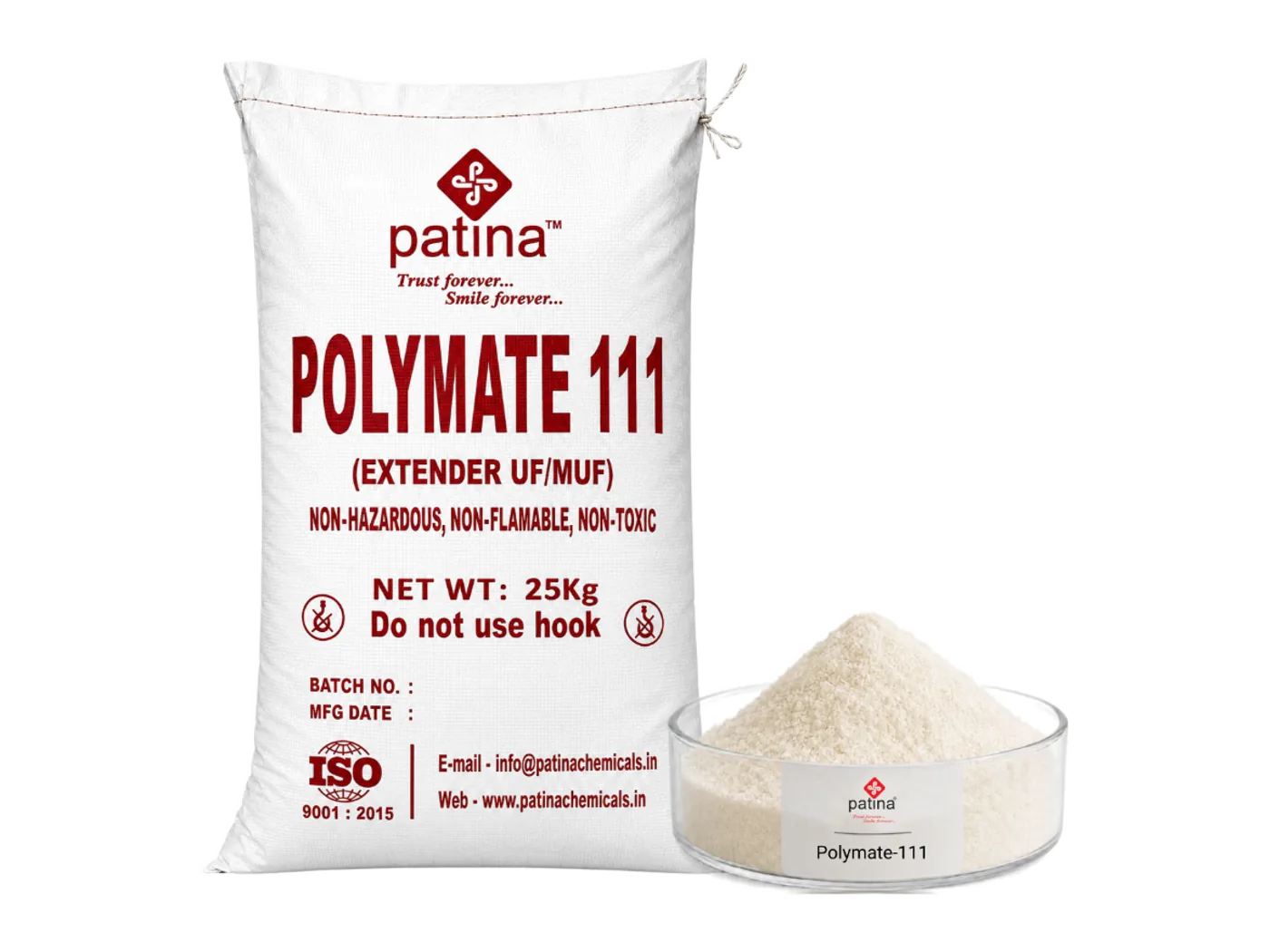
Polymate-111 is built against the second failure in particular: it raises the viscosity of the mix quickly and forms a physical barrier within the adhesive matrix, keeping the adhesive where the inter-layer bond needs it rather than letting it wick into the core.
Dose is a rheology decision, not a cost decision
The rate that matters is 4 to 5% maximum. That is not a budget ceiling — it is where the rheological balance sits. Below it you are leaving conservation on the table; above it viscosity climbs past what the spreader can lay down evenly, and an uneven spread costs more in rejects than the resin ever saved.
This is the part worth being unromantic about. Extension is judged on cost per square foot of finished panel, not cost per kilo of mix. A cheaper filler that forces a slower press cycle or lifts your reject rate is not cheaper.
What the test data says
Patina submitted Polymate-111 to the Indian Plywood Industries Research & Training Institute at Kolkata for testing against IS 848:2006, the Indian standard for synthetic resin adhesives for plywood. Panels were made to declared manufacturing conditions and tested as MR grade.
- MR grade, three cycles. No separation of plies at the edges or surfaces at the end of three cycles.
- Wood failure: 60%. IS 848 sets the pass standard at not less than 50%, with more than 75% counted as an excellent bond. Sixty per cent is a clear pass — the failure is happening in the timber, not in the glue line.
- pH of the cured film: 7.78, against a requirement of not less than 2.0. Comfortably neutral, which matters for long-term stability and for anything the panel is later finished with.
Worth being precise about the scope: this submission was tested as MR grade. The BWP and BWR boiling cycles are recorded as not applicable on the report, so nothing here is a claim about boiling-water performance. The full report is available on the Polymate-111 page if you want to read the method rather than take our summary of it.
Running the trial
The same discipline that applies to any glue-line change applies here, and for the same reason: if two things move, the result cannot be attributed to either.
- Record the baseline properly. Current resin consumption per square foot, viscosity at the spreader, press cycle, and the bond result you are getting today.
- Start at the recommended dose. Work down from 4–5%, not up from nothing. The upper end is where the rheology is designed to sit.
- Watch viscosity at the spreader, not in the bucket. The mix behaves differently after it has been sitting and after it has been worked. Measure where it is applied.
- Hold the press cycle fixed. Prove the extender works inside your existing process before you try to shorten anything.
- Test bonds after conditioning. Extension failures show up on the second test, not the first. A panel pulled straight off the press tells you very little.
Where a booster fits alongside
Extenders and boosters get confused because both are powders that go into the same mix, but they are answers to different questions. An extender conserves resin and controls penetration. A booster lifts the performance of the resin that is there — viscosity, tack and bond strength — which is what you reach for when the constraint is pre-press slippage rather than cost.
Mills running both usually arrived there by solving one problem at a time, which is the right order. Change one, measure, then decide whether the second is still needed.
The short version
Extension is a rheology decision wearing a cost decision’s clothes. Get the viscosity and penetration right and the resin saving follows without argument; chase the saving directly and you will find the ceiling the expensive way, on a batch of delaminated panels.
If you want to run the numbers for your own line, tell us your resin system, spreader settings and current consumption and we will suggest a starting dose.